
The system is under more strain than most people realize
The people who keep 911 running are doing extraordinary work under worsening conditions. The most recent national data makes the strain concrete:
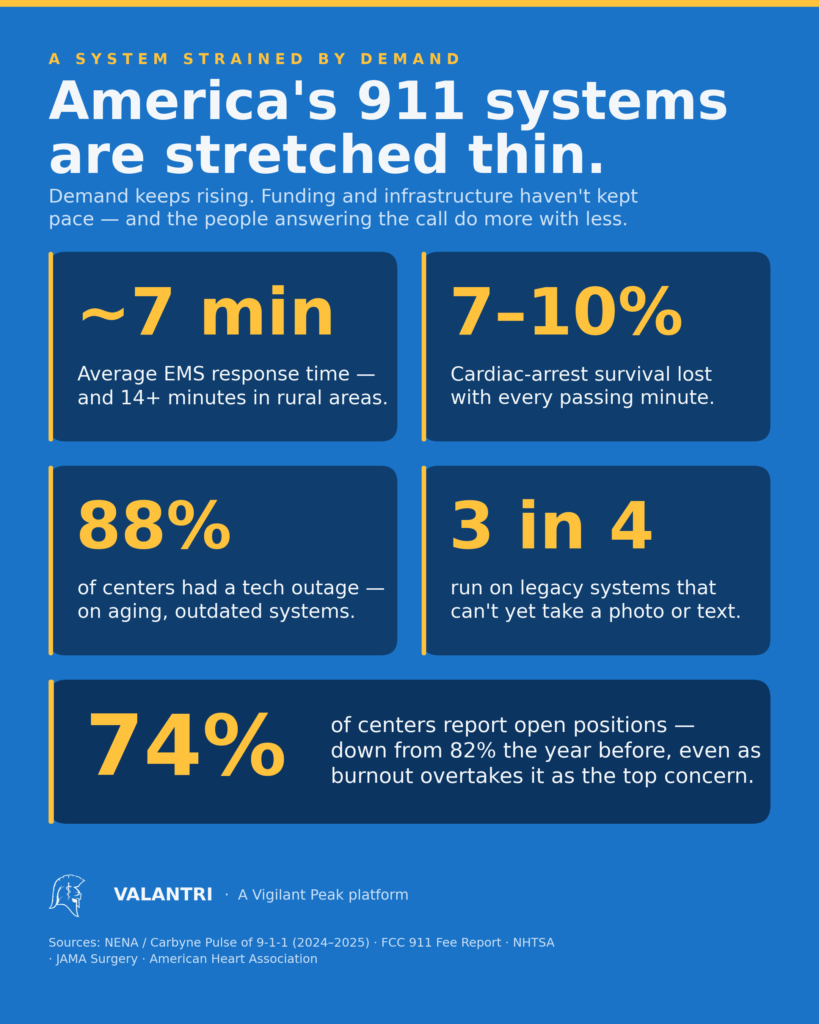
- 88% of emergency communications centers had a technology outage in the past year — up sharply from 75% the year before. (2025 Pulse of 9-1-1 report, Carbyne & NENA)
- Nearly 1 in 10 centers reported a cyberattack, such as a telephony denial-of-service attack — a new and fast-growing threat to emergency readiness. (Same report)
- Roughly 3 in 4 centers still run on legacy systems that can’t yet receive a photo or text — capabilities residents now take for granted. (Next-generation 911 adoption)
- 74% of centers report open positions — down from 82% the year before, even as burnout overtakes recruitment as the top concern for the workforce that keeps the system running. (2025 Pulse of 9-1-1 report)
This isn’t a story about people failing. It’s a story about an essential public system being asked to do more with less, year after year.
Why “average response time” is the wrong number to trust
The often-cited national figure is an average EMS response time of around 7 minutes — and 14 minutes or more in rural areas (NHTSA / JAMA Surgery). On paper, seven minutes sounds manageable. In an actual emergency, it isn’t.
In a cardiac arrest, survival odds fall by roughly 7–10% for every minute that passes without intervention (American Heart Association). Do the math on a seven-minute wait and the picture is sobering. And an average hides the worst cases — the calls that take far longer because of an outage, a short-staffed shift, or a responder struggling to find an address inside a large property with private roads and locked gates.
The number that actually matters isn’t the national average. It’s this: when something happens to you, how long until someone capable is standing there? For most of us, that answer depends entirely on a public system that — as the data shows — is increasingly stretched.
What this means for your property
None of this is a reason to panic, and none of it is a knock on 911 professionals. It’s a reason to think clearly about the gap — the minutes between when something goes wrong and when public help arrives — and who fills it.
For HOAs, senior living and healthcare facilities, commercial spaces, and high-end residential properties, that gap is exactly where an on-site safety layer earns its place. Not to replace 911, but to make sure that in the first critical minutes, a trained, capable person is already on scene while the public system does its part.
This is the human-first model in practice. Technology identifies the problem in seconds; people decide and act. The goal isn’t more cameras and alerts for their own sake — it’s getting a capable human to a person in need faster, and being able to prove it. When the public system is under this much strain, that on-site readiness stops being a luxury and starts being the difference.
Frequently asked questions
Are America’s 911 systems really overwhelmed?
The strain is well documented. The 2025 Pulse of 9-1-1 report found 88% of emergency communications centers had a technology outage in the past year, and while open positions eased to 74% (down from 82%), burnout has overtaken recruitment as the top workforce concern — alongside new cyber threats.
What’s the average 911 / EMS response time?
Roughly 7 minutes nationally, and 14 minutes or more in rural areas (NHTSA / JAMA Surgery) — but averages hide the longer waits caused by outages, staffing gaps, and hard-to-navigate properties.
Why does response time matter so much in a cardiac emergency?
Survival odds drop by about 7–10% for every minute without intervention (American Heart Association), so even a few minutes’ delay dramatically changes outcomes.
Can a private safety provider fix the 911 system?
No — and that’s not the goal. An on-site safety layer fills the critical first minutes with a trained responder on scene, working alongside public 911, not replacing it.
Why are 911 centers running on outdated technology?
Funding and infrastructure haven’t kept pace with demand, leaving many centers on legacy systems that can’t yet handle modern needs like text or photo.
Valantri provides safety and rapid emergency response for luxury HOAs, senior living and healthcare facilities, commercial spaces, and high-end residential properties. Talk to us about a safety assessment for your property.